
饥饿游戏
First regular Arctic container service China-Europe Arctic Express set to debut this week, ship operator tells GT_我的网站

A | “Every role we take on simply expands the responsibility we already carry within.” The words felt inherent to the space… Ashish Shelar is a prominent Indian politician, lawyer, and one of Mumbai’s most recognisable public leaders. A senior figure in the Bharatiya Janata Party, he has served multiple terms as an MLA from Bandra West and held key organisational roles, including President of the Mumbai BJP. Known for his sharp legal mind and grassroots connections, Shelar has played a significant role in shaping Mumbai’s civic and developmental policies, championing issues related to education, urban infrastructure, and youth empowerment. He currently serves as the IT Minister and Cultural Minister of Maharashtra, roles in which he is driving digital growth, creative advancement, and cultural preservation across the state. Beyond politics, Shelar is deeply associated with sports and community initiatives. As former President of the Mumbai Cricket Association, he has supported major sports infrastructure and talent development. A Bandra boy at heart, Ashish Shelar remains an influential voice in Mumbai’s evolving public life. To understand Ashish Shelar is to recognise a figure shaped as much by Mumbai’s vibrant energy as by its quieter, inherited traditions. He is a man who has risen through the city’s layered terrain without severing himself from the places that first formed him. Years spent in a modest chawl did not merely define his beginnings; they created a lifelong grammar of community, discipline and instinctive empathy. His journey is not the familiar arc of a politician sculpted by circumstance, but that of a man who learned early that responsibility grows not from opportunity but from exposure to collective life. Those formative corridors shaped his sense of belonging long before public leadership entered his vocabulary. Even today, beneath the roles he carries, there remains the unmistakable presence of someone who has listened closely to the city’s heartbeat. He understands its festivals and its silences, its ambition and its anxieties, its need for celebration, and its longing for continuity. In Shelar’s public persona, there is a rare blend of assertiveness and accessibility, a combination that allows him to move with equal ease through the institutional corridors of government and the lived reality of people’s everyday concerns. He stands as part of a generation of leaders who have witnessed Mumbai reinvent itself repeatedly, and he carries those transformations within him with a sense of responsibility that feels both personal and civic. The door opened with the quiet certitude of a room designed for conversation rather than display. Inside sat Ashish Shelar, composed and unhurried, carrying the ease of someone who has grown from the same soil as the city he serves. Nothing about the setting felt performative. It had the atmosphere of a familiar Mumbai afternoon where stories drift into the air long before they were spoken aloud. As Rachana Shah and Rhythm Wagholikar took their seats, the room softened into a steady rhythm. Shelar seemed intent on speaking not as a political figure but as a man shaped by the everyday pulse of the city that raised him. What followed was an interaction that moved with an unforced grace. It was a conversation that did not rush to conclusions but allowed insights to surface with their own natural cadence. Memories blended with reflections, personal anecdotes mingled with convictions, and the portrait of a leader quietly deepened. By the time the discussion drew to a close, it felt less like an interview and more like a window into the making of a man who continues to carry Mumbai within him. The interview was warm, engaging, and revealing in its own gentle way, unfolding with the ease of a story that simply needed the right moment to be told. What follows are curated excerpts from a candid and wide-ranging interview with Ashish Shelar, conducted by Rachana Shah and Rhythm Wagholikar…. You grew up in a period that shaped Mumbai’s cultural and social identity. What part of that childhood shaped you? My childhood in a Mumbai chawl was my first schooling. Life unfolded in proximity. You heard your neighbour’s joys and anxieties; you witnessed their efforts and celebrations. You grew into every festival, every household, every shared courtyard. That instinct for coexistence shaped me long before I understood the words for it. It taught me informality, empathy, and a rhythm of belonging that no structured education can offer. Before public life found you, who were you as a young student or dreamer? I was a struggler. There was no early ambition for leadership or public life. I worked hard for better education, for opportunities that seemed modest at the time but mattered immensely. Circumstances kept illusions at a distance. Looking back, I now understand that destiny or perhaps the guidance of my Sadguru had placed the path long before I recognised it. Faith remains central to your life even with the pressures of public responsibility. What sustains that connection? I like being with people. Service has always felt natural to me, whether in development work, healthcare assistance or simple presence. Temple visits are an extension of the same instinct. They keep me aligned with the inner rhythm I rely on. Mumbai has reinvented itself many times. What is the soul of the city today?The soul of Mumbai lies in shared celebration. A society thrives when people come together. In my childhood, Navratri nights, Devikala Utsav, Vrinda Utsav and small school gatherings were part of our emotional landscape. I used to write the display boards for competitions. These details may appear small, but they created belonging. Keeping that spirit alive feels like an essential responsibility. Was there a turning point that shaped your entry into public life? When our chawl was demolished, we moved to Bandra. I was in class four. That move brought me to the RSS Shakha. I entered first to play but soon absorbed the discipline, the stories of Chhatrapati Shivaji Maharaj, the call of Vande Mataram and an early understanding of patriotism. Later came my years with ABVP as a full-time worker and then my journey through the BJP and Yuva Morcha. Each stage introduced its own discipline and widened my worldview. Among the cultural responsibilities you have held, which initiative remains closest to your heart? The UNESCO recognition of the twelve forts of Chhatrapati Shivaji Maharaj as a world heritage ensemble. Eleven forts in Maharashtra and one in Jinji, Tamil Nadu, were brought together under the understanding of the Maratha Military Landscape. For an entire cluster to receive recognition is rare. It has added significant value to our cultural and historical preservation, and this is one thing I hold closer to my heart. If you could highlight a lesser-known cultural treasure of Maharashtra, what would come to mind? There is no single answer,” he quietly smiled. “Our cultural depth stretches across languages, classical and semi-classical music, the energy of Lavani, the strength of theatre traditions, the devotion of the Varkari movement and the architecture of old temples and wells. Much of it has to be experienced rather than described.Politics can be emotionally demanding. How do you maintain balance? Sadhana. My connection with my guru. The guidance of Sai Baba. Daily discipline keeps the mind centred and prevents unnecessary restlessness. If you could pass on three cultural values to the next generation, what would they be? Humility, a mind free of ego and an alignment with nature. When you listen to your inner voice and stay close to nature, life aligns itself with you. Do sports, cinema and literature influence the modern Maharashtrian mindset? Human beings evolve through sensitivity. Films, music and theatre nurture emotional intelligence and expand imagination. They prepare individuals to be receptive and grounded. When your journey is written someday, which chapter would you hope stands out? I do not wish for any chapter to carry my name. Like for example, bringing back the historic sword of Chhatrapati Raghuji Raje Bhosale from London was meaningful, but it belongs to Maharashtra, not to any individual. Our life should be a dedication to humans and humanity. From grassroots worker to cultural minister, what essence defined the transition? Every stage widens your canvas. A ground worker thinks for the locality. A party worker thinks for the organisation. A representative thinks for the constituency. A minister thinks for the state. The thread that binds all stages is the ability to think for others. As the conversation drew to a natural close, the room remained exactly as it had been at the beginning, quiet and steady, untouched by the weight of the words that had passed through it. He carried the city’s shifts within him. He understood its silences, its speed, its contradictions, and its spirit. For Rachana Shah and Rhythm Wagholikar, the interaction became a portrait of a man shaped by Mumbai and now shaping it in return, with a clarity that felt both measured and unmistakably sincere. Also Read: Highlights From The 10th Filmfare Awards Marathi 2025。
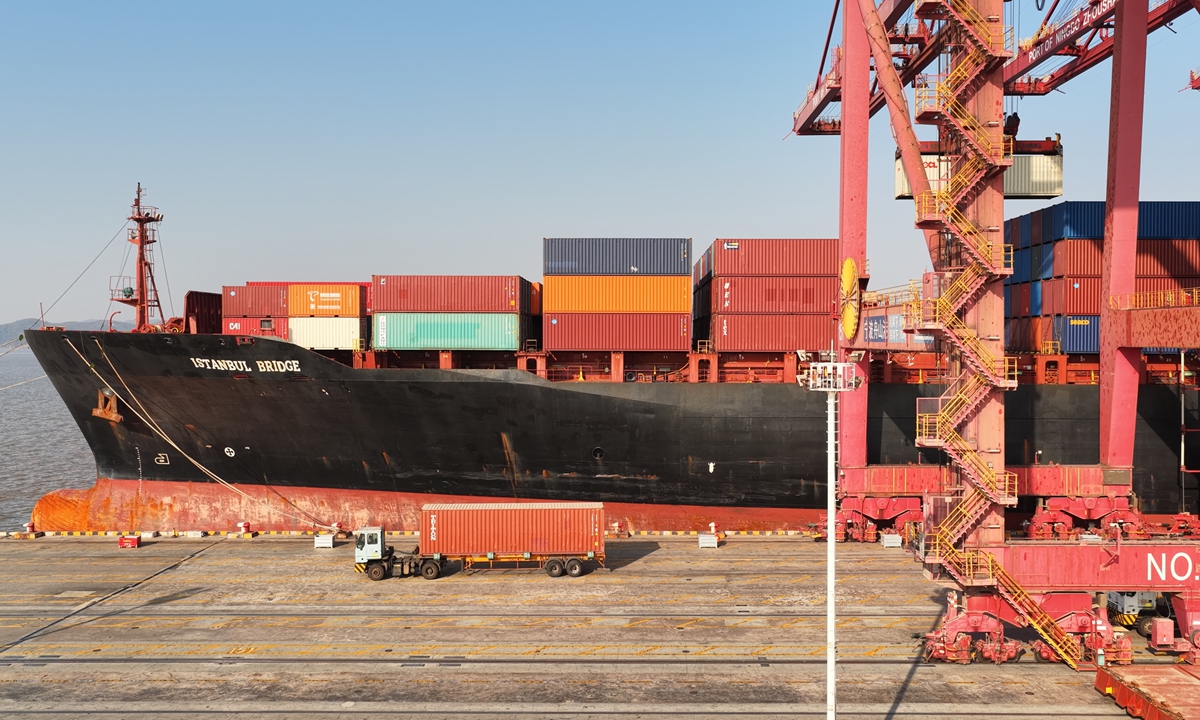
A Chinese shipping company has confirmed with the Global Times the plan to launch a regular container service via Russia's Northern Sea Route to Europe this week, marking a new Arctic option for Asia-Europe trade once it sets sail.
Chinese container shipping company Sea Legend Shipping told the Global Times on Tuesday that its vessel Dubai Tower, originally scheduled to depart Ningbo-Zhoushan Port in East China's Zhejiang Province, on August 15, has had its departure adjusted because of weather conditions. The company said it is making internal arrangements for the maiden voyage of the China-Europe Arctic Express Route.
According to industry observers, the move reflects growing interest in Arctic shipping as global logistics networks continue to diversify beyond traditional canal routes. As polar ice retreats and seasonal navigation windows widen, the Arctic is emerging as a practical alternative for some Asia-Europe shipments, particularly those seeking to avoid congested or geopolitically sensitive sea lanes.
On Monday, the Financial Times reported that Sea Legend would launch the first regular container shipping service through the Arctic this week. The report said the company has branded the service the "Ice Silk Road," a reference to the historical Silk Road linking China and Europe.
The move comes as Arctic shipping increases amid rapidly shrinking sea ice. The Northern Sea Route recorded a record 23 transits last summer, up from 15 in 2024, according to figures cited by the FT.
Sea Legend told the Global Times that, compared with traditional China-Europe routes that can take around 40 days, the Arctic passage could cut transit time by nearly half, reducing the journey to about 20 days under direct service conditions.
The inaugural voyage is expected to call at Qingdao Port, Shanghai Port, Taicang Port and Ningbo-Zhoushan Port in China before continuing to European ports including Teesport and Felixstowe in the UK, Hamburg in Germany and Gdynia in Poland. The final domestic calling sequence may still change due to typhoon-related weather conditions.
The service will carry cargo including energy storage containers and related components, power batteries and new energy vehicles - goods that typically require faster transit, stable schedules and controlled transport conditions.
Sea Legend said the Arctic route could offer exporters a new solution in terms of both speed and reliability, as traditional canal and mainline routes face growing uncertainty from congestion, geopolitical disruptions and longer port waiting times.
The company also said the route has cooperation agreements with destination terminals including Felixstowe, Rotterdam, Wilhelmshaven and Antwerp, giving vessels priority berthing and a "green channel" advantage that could reduce anchorage delays and logistics costs.
Zhong Zhechao, an international logistics service expert told the Global Times on Tuesday that the move highlights rising interest in using the Arctic region for shipping, with Arctic shipping gradually becoming a practical alternative in the global logistics network as melting ice expands seasonal navigation windows and shipping lines seek to avoid congested and geopolitically sensitive sea lanes.
For exporters - especially cross-border e-commerce firms, manufacturers of seasonal products, and new energy companies - shorter shipping times could ease inventory pressure and reduce working-capital costs by allowing more flexible production and sales planning.
Zhong said this may be particularly valuable for companies racing to meet European sales seasons, as shorter transit times improve responsiveness to overseas demand.
The company also said the Arctic's low-temperature environment may be especially suitable for transporting new energy products such as batteries and energy storage systems, which require heightened attention to safety and thermal-risk considerations during transit.
Looking ahead, Sea Legend aims to achieve roughly four months of stable annual operation within the next three to five years, with a longer-term goal of year-round Arctic navigation within five to ten years.
The launch underscores how Chinese shipping firms are accelerating their Arctic deployment, turning what was once a long-term vision into operational reality.
According to the Xinhua News Agency, in September 2025, Ningbo-Zhoushan Port launched its first China-Europe Arctic container express route. The move was expected to provide strong support for trade enterprises to expand into new international logistics channels, the port said.
In recent years, Arctic shipping routes have increasingly come under the spotlight in the international community and have the potential to become important routes in international trade, Lin Jian, Chinese Foreign Ministry spokesperson, told a press conference in September 2025.
China stands ready to work with Russia and other Arctic states as well as interested countries to strengthen international cooperation on the building and operation of basic infrastructure along Arctic shipping routes and jointly advance the development and exploration of the routes and protect the environment there, Lin said.
。

B |
Current article:http://aqcr7ht.minpinpengcemiuanjiuxuan.pics/list_49s5hk/uv7.html
Published on:04:47:02