3c认证
EconoScope | Hoshine case puts U.S. forced-labor enforcement to the test_我的网站

A |
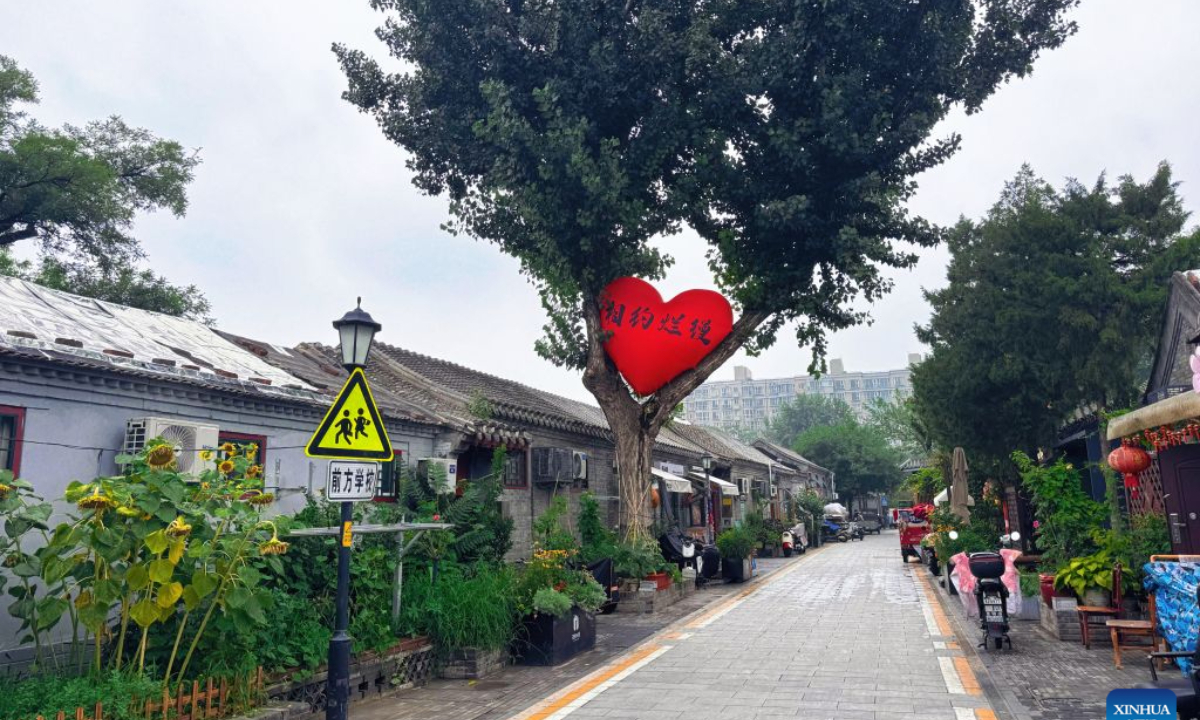
This photo taken on July 10, 2026 shows a view of Lanman Hutong in Beijing, capital of China. (Xinhua/Zheng Keyi)Just after six each morning, 63-year-old Chen Zhongyi unlatches the wooden door of a pigeon loft outside his home in Beijing's Lanman Hutong. Within seconds, more than 20 homing pigeons burst into the sky, circling above the grey-tiled roofs before fanning out across the city.
"That's when I feel happiest in the day," Chen said, his gaze following the birds as they fade from view.
For Chen, who has spent his entire life in this narrow alley, the pigeons are far more than a pastime. They embody a way of life that has long defined the character of Beijing's historic hutongs.
A city with over 3,000 years of recorded history, Beijing has constantly grappled with how to modernise without erasing its past. Lanman Hutong, tucked in the city's core, offers a compelling case study in urban renewal that honours neighbourhood memories while leaving room for the new.
OLD ALLEY, NEW LIFE
When Lanman Hutong launched a major renovation in 2018, Chen feared his hand-built pigeon loft, a fixture since 2013, might have to come down.
To his relief, the designers had other plans. "Pigeons are part of old Beijing's culture," they told him. "They should stay, and we'll upgrade the loft."
The birds were soon moved into a new wooden structure -- brighter, sturdier and better ventilated. "It wasn't just a new pigeon house," Chen said. "It told me that what we treasure can endure."
He was not alone in witnessing the change. Zheng Enqing, 78, who has lived in the neighbourhood for over three decades, recalled the alley's former chaos: cars crammed into every available space, pedestrians squeezing past.
Today, the rough pavement has given way to neatly laid grey bricks, and a nearby multi-story parking facility has freed the lane for foot traffic.
Yet for Zheng, the most telling improvements were those shaped by residents themselves.
When an outdoor air-conditioning unit began blasting hot air onto his prized grapevine, he raised it with the neighbourhood committee.
"They listened," Zheng said, noting that this responsiveness, for him, defined the entire renewal. The unit was moved to the rooftop and screened with a structure that blends with the historic surroundings.
"Our goal was to improve the environment while letting residents keep their way of life," said Chen Qinghong, planning manager at Beijing DeYuan Dade Real Estate Investment Co., Ltd., the project developer.
Chen added that over 100 consultation meetings were held with locals before and during construction, covering everything from parking to landscaping and public facilities.
"Urban renewal should not ask residents to adapt to redevelopment," said Song Jingyang, an official with the Beijing Municipal Commission of Urban Management. "Rather, redevelopment should adapt to the people."
A LIVING COMMUNITY
For planners, however, upgrading the physical fabric was only the first step.
In 2023, Lanman Hutong introduced a voluntary relocation program, letting residents decide whether to stay or leave. Vacant courtyards were then gradually opened to businesses and cultural ventures suited to the historic district's character.
By early 2026, 641 households in the Fayuan Temple Historic District, where Lanman Hutong sits, had opted for relocation, making room for 105 new businesses. Cafés, bookshops, restaurants and cultural studios have since taken root in centuries-old courtyards.
Zheng, who chose to stay, admitted that the newcomers have shifted his outlook. "At first, I thought cafés were only for young people. Now I believe we older residents should also embrace these changes," Zheng said.
He is also cheered by the growing number of young faces in the alley. "That's exactly the kind of change we want to see," he said.
Among them is 23-year-old Hu Feixiong, a graduate student at Beijing University of Civil Engineering and Architecture.
Earlier this year, Hu and his teammates moved into a youth entrepreneurship space in Lanman Hutong, where they began offering architectural cultural products, including layered refrigerator magnets inspired by Beijing's landmarks, directly to customers in a real neighbourhood.
"We only pay basic utility costs, yet we can meet customers, test our products and refine our ideas in a living community," Hu said. Rather than remaining on design sketches or screens, their creations now reach visitors face-to-face in one of Beijing's oldest quarters.
In this way, the city's architectural heritage endures not just through preservation but through the ingenuity of a new generation.
"It is the interaction among residents, businesses and the community that keeps a neighborhood alive," said Wang Mingjun, an official with the Xicheng District Urban Management Committee. "Urban renewal is not a one-off project. It is an ongoing process in which everyone has a role to play."
Official data show that since 2017, more than 5,200 backstreets and alleys in Beijing have undergone environmental upgrades, with resident satisfaction steadily rising.
That approach reflects a broader shift across China. In Jinfeng Town, southwest China's Chongqing Municipality, for instance, residents are pinning their hopes on ongoing renewal projects to raise living standards further.
Under the urban renewal plan for the 15th Five-Year Plan period (2026-2030), China aims by 2030 to build cities that deliver a high quality of life for all -- a vision that, in Lanman Hutong, is already taking shape.
。
(ECNS) -- U.S. restrictions on Chinese companies over alleged “forced labor” are facing growing scrutiny, both over the facts behind such accusations and the legal procedures used to enforce them. Recently, U.S. Customs and Border Protection (CBP), under the Department of Homeland Security, updated its records to remove Hoshine Silicon (Jia Xing) Co., Ltd., a Chinese photovoltaic supply-chain company, from the scope of a Withhold Release Order (WRO) related to alleged forced labor in Xinjiang. Li Guogang, senior legal counsel at Tahota Law Firm who represented Hoshine Silicon, told China News Network that this is the first known case of a Chinese company being removed from the scope of such a U.S. enforcement measure related to Xinjiang. He described it as a milestone for Chinese companies seeking to challenge U.S. actions involving alleged forced labor.
From being targeted to having to prove its innocence In recent years, the U.S. has repeatedly used WROs and Xinjiang-related legislation to impose trade restrictions on Chinese companies. For businesses caught up in such enforcement measures, proving that their products and supply chains are not connected to alleged forced labor can become a major hurdle. The Hoshine case highlights the difficult burden placed on companies facing such measures. Rather than authorities being required to disclose the full basis for their allegations through a transparent process, affected companies may find themselves having to submit extensive evidence to demonstrate that the accusations against them are unfounded. “We submitted 4,000 to 5,000 pages of materials, including audit results and detailed explanations of the supply chain, to demonstrate that the allegations of forced labor against Hoshine Silicon were without factual basis,” Li said. The company’s experience also shows how difficult it can be for businesses to challenge such enforcement actions. According to Li, U.S. customs authorities initially rejected Hoshine Silicon’s applications for removal twice. The situation changed after the company took the case to the U.S. Court of International Trade. The dispute subsequently moved through judicial proceedings, and the enforcement measure was eventually lifted as it applied to Hoshine Silicon. The shift from administrative enforcement to judicial review is significant. It shows that when allegations lack sufficient factual support, legal procedures can still provide companies with an important avenue to seek relief and challenge government decisions.
The significance goes beyond one company The significance of the Hoshine case lies in more than one company being removed from the scope of a U.S. trade restriction. In recent years, U.S. restrictions on Chinese companies have expanded far beyond traditional tariffs, extending into supply chains, investment, technology and national security. Issues involving Xinjiang and alleged military ties have also increasingly become part of Washington’s economic policy toolkit toward China. One direct result is greater uncertainty for Chinese companies seeking to enter or operate in the U.S. market. Businesses must consider not only product prices, quality and competitiveness, but also the additional risks created by shifts in U.S. domestic politics and regulatory policy. China’s Ministry of Commerce has repeatedly stated that Xinjiang enjoys social stability, economic development and improving living standards, and that there is no forced labor of any kind in the region. A recent case involving Chinese pharmaceutical and life-sciences company WuXi AppTec offers another example worth watching. The company has also challenged its designation by the U.S. Department of Defense as a “Chinese military company.” A U.S. court recently granted WuXi AppTec a preliminary injunction, temporarily blocking the designation while the case proceeds. The court found that the company was likely to succeed in arguing that the Defense Department’s decision was arbitrary and capricious, pointing to problems in how some of the evidence had been interpreted. From Xinjiang-related restrictions to military-related designations, the U.S. government has increasingly brought political and national-security considerations into its treatment of Chinese companies. When political tools are repeatedly used to blacklist Chinese businesses, the consequences go beyond the outcome of a single lawsuit. They can also affect global companies’ confidence in the predictability of the U.S. market and its legal and regulatory environment. If companies must spend enormous amounts of time and money simply to demonstrate that allegations against them lack sufficient evidence, questions inevitably arise over whether confidence in U.S. market rules and legal institutions can be sustained. Commercial rules ultimately depend on institutions that are stable, transparent and predictable. When administrative power increasingly intervenes in normal international trade, and when market risks depend more heavily on political judgments, the impact extends beyond one company or one supply chain. It can shape global businesses’ long-term expectations of the stability and reliability of the U.S. market. The cases of Hoshine Silicon and WuXi AppTec have therefore opened more than a gap in individual blacklists. They have exposed a potential crack in the broader machinery of U.S. sanctions and restrictions. When allegations fail to withstand legal scrutiny and enforcement actions lack sufficient factual support, the credibility of those measures inevitably comes into question. For Chinese companies, the message from these cases is clear: being placed under a U.S. restriction does not necessarily mark the end of the story. Evidence, legal procedures and judicial review can still challenge administrative decisions — and, in doing so, expose weaknesses in U.S. enforcement actions driven more by political considerations than by solid evidence. (By Gong Weiwei)


。

B |
Current article:http://aqcr7ht.minpinpengcemiuanjiuxuan.pics/yjd/pfcbpou.html
Published on:17:54:53

 。
。